Performance Architecture
From Institutional Intelligence to Integrated Action: How Clubs Turn Shared Knowledge into Performance
A club only becomes intelligent when shared knowledge changes specialist work, player development and collective decisions without fragmenting the performance system.
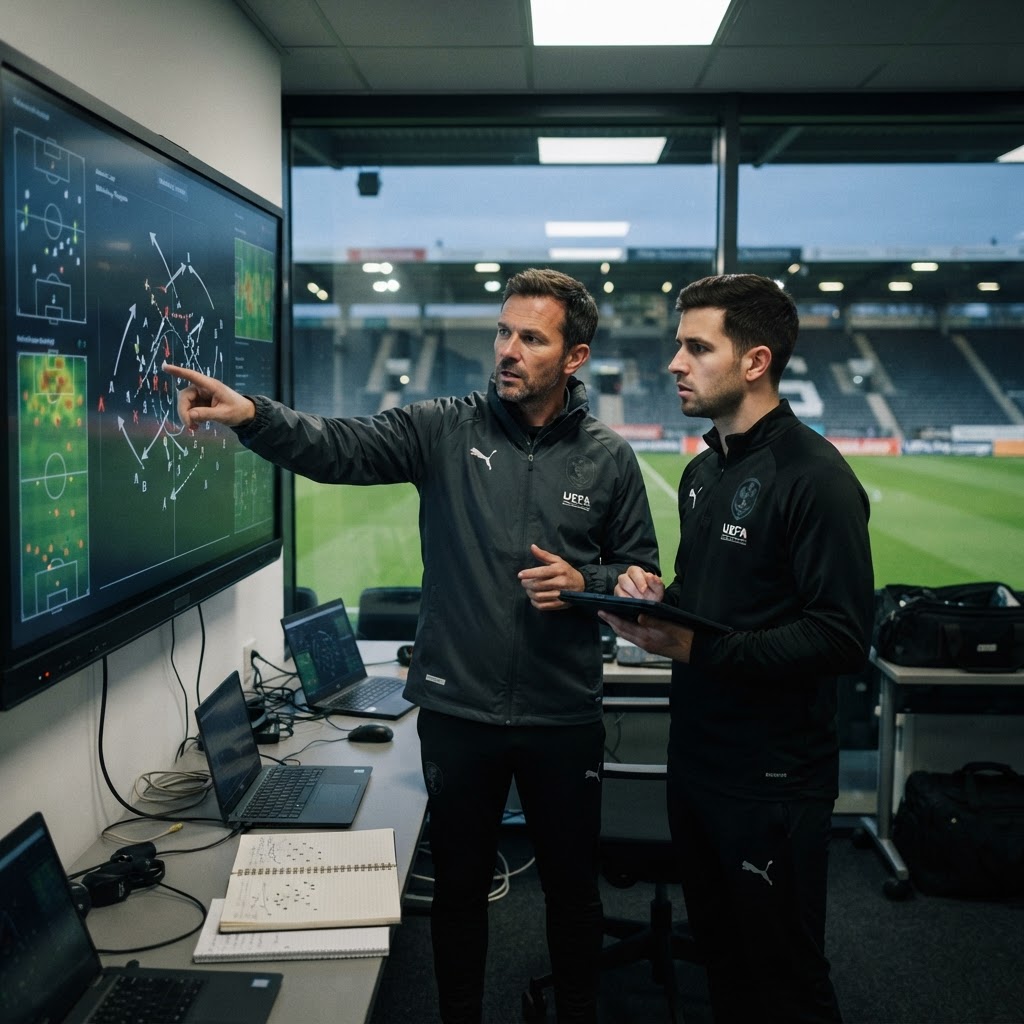
Professional football is not short of specialists. It is short of architectures capable of making specialist work reinforce the same performance objective.
Last week, we explored the transition from data to institutional intelligence: OBSERVE → DIAGNOSE → DECIDE → INTERVENE → COMPETE → VERIFY → LEARN → INSTITUTIONALIZE.
This week, the next question is unavoidable:
What happens after the club has learned?
If the lesson stays inside a report, a meeting or one person’s head, nothing structural has changed. Institutional intelligence only becomes valuable when it modifies the way coaches, analysts, physical staff, medical staff, methodology departments and players act together.
1. The hidden problem: specialization without integration
Modern clubs need specialization. Analysts must analyze. Strength and conditioning coaches must protect and develop physical capacity. Medical departments must manage availability. Individual development coaches must work on specific player needs. Sporting directors must protect the club’s medium- and long-term direction.
The problem begins when each specialist works from a separate logic.
Then the club has expertise, but not architecture.
The PONS Method does not propose eliminating specialization. It proposes Integrated Specific Fragmentation: every discipline keeps its real specificity, but all disciplines operate inside a shared performance framework.
The objective is not uniformity. The objective is coherence.
2. A new operational sequence
The practical architecture can be expressed as:
CLUB INTENT → GAME MODEL → PERFORMANCE PRIORITIES → SPECIALIST INTERVENTION → TRANSFER SIGNALS → MATCH EVIDENCE → SHARED LEARNING
This changes the question each department asks.
The analyst no longer asks only, “What happened?” The analyst asks, “What information changes the next decision?”
The physical coach no longer asks only, “What load does this player need?” The question becomes, “What physical capacity does this player need to execute his function inside our game?”
The individual coach no longer asks only, “What technical action can we improve?” The question becomes, “Which perception, relationship and decision must this player solve more effectively in the collective context?”
The methodology department no longer exists to produce exercises. It exists to connect these questions.
3. Collective Individualization
This is where another core PONS principle becomes operational: Collective Individualization.
Individualization does not mean removing the player from the team logic. It means adapting the system to the player without breaking collective coherence.
A midfielder can train alone and still reproduce collective relationships. A rebounder can represent a teammate, a passing line, a body orientation, a second relationship, progression or the next action. The player may be physically alone, but the task can still contain the information structure of the game.
The hierarchy matters:
GAME MODEL → POSITION → FUNCTIONS → RELATIONSHIPS → TASK DESIGN → COGNITIVE OR PHYSICAL STIMULUS
Not the other way around.
Technology, cognitive tools, GPS, AI, rebounders, data platforms or recovery systems are valuable. But they are modules. Architecture decides how they are used.
4. The transfer test
Every specialist intervention should pass one test:
What evidence will tell us that this work transferred to competition?
If the answer is unclear, the intervention may be useful, but the club cannot learn from it.
A performance system should define transfer signals before the work begins. Those signals can be tactical, technical, physical, behavioral or organizational. What matters is that the club knows what it is trying to change and how that change will be verified.
This closes the loop between training and competition.
Without verification, clubs accumulate activity. With verification, they accumulate learning.
5. Why this matters for sporting leadership
For a sporting director or technical director, integrated action creates something more valuable than efficiency: continuity.
When the coaching staff changes, the club should not lose its language, decision criteria, player-development history, performance priorities and learning mechanisms.
The new coach can bring new ideas. The staff can evolve. The game model can change. But the organization should not return to zero.
This is the difference between a club that depends on professionals and a club that learns through professionals.
COACHES COME AND GO. SYSTEMS REMAIN.
6. The international challenge
This principle is especially important across different football cultures.
Methods cannot be exported as rigid recipes. Contexts differ: league demands, player profiles, resources, staff structures, training culture, club identity and competitive calendars.
A scalable methodology therefore needs two simultaneous qualities:
Structural consistency and contextual adaptability.
The architecture remains. The content adapts.
This is why the PONS Method is designed as a performance operating system rather than a fixed playing philosophy. It can organize different identities without replacing them.
7. The next evolution
The next stage of high performance is not simply better data, better AI or more specialists.
It is the capacity to make every specialist intervention part of one learning architecture.
When that happens:
better observation improves diagnosis;
better diagnosis improves priorities;
better priorities improve specialist work;
better specialist work improves transfer;
competition produces evidence;
evidence becomes shared learning;
and shared learning changes the next cycle.
That is how performance becomes systemic.
That is how methodology becomes operational.
And that is how a club stops collecting knowledge and starts building institutional intelligence that can act.